Flameless heater rental from 425,000 to 1.2 million BTU/hr. Three Therm Dynamics units, rent-only, each one diesel-fired, trailer-mounted and self-contained. They ship from Red Deer with the engine, fuel tank and controls already on the trailer.
Three kinds of temporary heat turn up on Alberta job sites. Only one of them leaves the burner off the site altogether.
A direct-fired heater burns its fuel inside the space it is heating, so the flame goes wherever the work goes. A flameless unit has no burner. Its heat comes from its own diesel engine, and the heating is flameless and sparkless. The longer case is in why flameless heaters are safer.
Many owners and operators write their own rules for open flame and hot work: permits, fire watches, and areas where no burner is allowed at all. Those rules are aimed at the flame. A heater without one is a different question under most of them, which is why it is often the one let through the gate where a burner is refused. The site's own rules still decide, so check with whoever issues the permits before delivery.
An indirect-fired heater burns its fuel in a chamber outside the heated space and sends only warmed air in. It keeps combustion out of the air the crew breathes. It does not remove the flame. There is still a burner on site to account for.
Every heater listed here is for flameless heater rental only; none are for sale. The TD425 puts out 425,000 BTU/hr with an 84 gal tank. The TD625 puts out 625,000 BTU/hr with 200 gal, and the TD1200 puts out 1,200,000 BTU/hr with 210 gal. The grid below pulls from the live fleet, and each unit page carries the rest of its detail.


Heat is rarely the only thing a winter site needs: the full rental fleet shows what else can ship with it, and generator rentals across Alberta is where the generators for the same job are listed.
Four things decide it:
From the TD425 to the TD1200, the three units go up in output and in fuel on board. Your answers decide which one goes out, or whether the space takes more than one. That is worked out for each job, not read off a chart. This page has no rule of thumb because a rule of thumb is how a site ends up in January with a heater that cannot keep up. Sizing advice is free.
Temporary flameless heating for industrial use tends to be needed just when the site is already short of power. These heaters do not add to that.
The engine, heater, fuel tank and controls all ride on one trailer. Park it where the heat is needed, fuel it and start it. There is no burner fuel line to run and no spare circuit to find on the site panel.
Thermostat control, set up for remote sites. The heater holds the space at a set temperature, so nobody has to turn it up and down by hand between shifts.
The units shut themselves down automatically when something is out of range, and the engine has an overspeed air-intake shutoff as well. On a remote site that is the point: a fault ends with the heater stopped, not running unattended.
Sites that need heat are often already renting generation, distribution and fuel storage. Put the heaters on the same enquiry and the whole package comes back as one written quote. Construction site power shows how the rest of it fits together.
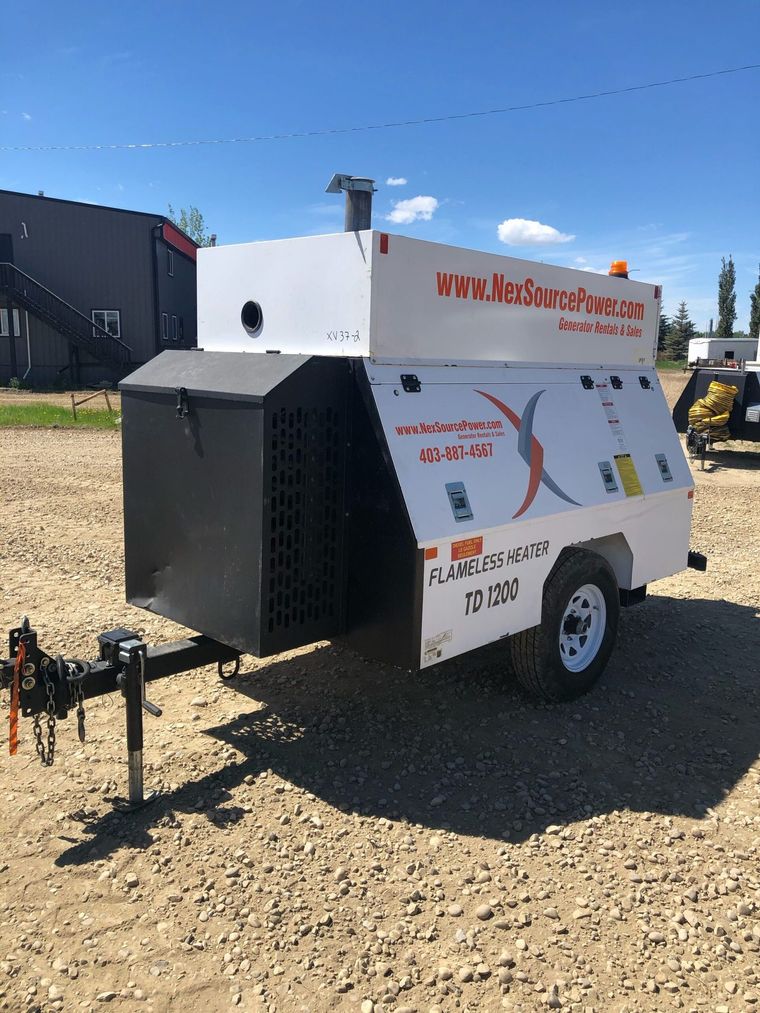
A flameless heater for construction sites earns its keep in four places.
Framing, masonry, finishing: work that stops when the temperature drops keeps going inside an enclosure held at temperature, with no burner inside the tarps. The tighter the hoarding, the less heater it takes.
Fresh concrete has to stay above the temperature its spec calls for until it has gained strength. Thermostat control holds the enclosure there overnight and through the weekend, with no flame beside the forms.
Engines, hydraulics and gearboxes left out overnight in a cold snap are slow and stubborn first thing. Heat on them before the shift gets the machines, and the crew, moving sooner.
A building that has taken on water, or needs to be dry before finishes go on, dries faster with heat in it. A flameless unit does that without bringing a flame into a space still full of materials and trades.
Builders adding a construction heater rental to the site's temporary power, for hoarded work and pours that cannot wait for spring.
Construction generator rental →Well sites and facilities where the operator keeps open flame away from the work, and a heater with automatic safety shutdowns suits a crew spread thin.
Oilfield production →Winter maintenance and equipment warm-up at sites where the generator already has enough to carry.
Mining →Northern jobs where heat and power go on one order, trucked up from Red Deer.
Generator rentals in Grande Prairie →No. An indirect-fired heater still has a burner. It keeps the flame in a chamber away from the air it heats, but the flame is there. A flameless heater has no burner at all: the heat comes from its own diesel engine, and the heating is flameless and sparkless. Where a site's rules are written around open flame, that is usually the difference that counts. Confirm it with the site before you book.
It depends on the enclosure, not on a chart. Send the volume of the space, the temperature it has to hold, the outside conditions you expect and how well the hoarding is sealed. From that we pick the unit (425,000, 625,000 or 1,200,000 BTU/hr), or more than one where a single heater will not hold the space. The advice is free.
No. Each unit runs on its own diesel engine and carries its own fuel on the trailer: 84 gal on the TD425, 200 gal on the TD625 and 210 gal on the TD1200. The generator stays sized for the site's electrical load, and the heat takes none of it. If the generator trips, the heaters are not relying on it.
Thermostat control holds the space at a set temperature, so nobody has to adjust the heater through the night. Automatic safety shutdowns stop the unit when something is wrong, and the engine has an overspeed air-intake shutoff as well. Tell us how the site is supervised and checked when you ask for the quote, so the setup suits the way it runs.
It is quoted per job. The unit, how long it stays on site, where the site is and what else goes on the same order all move the figure, so there is no rate card here. Tell us about the space and the schedule, and you get a written figure for that job. Help choosing the size is free either way.
Yes. Every heater ships from Red Deer, which is where NexSource works from, and goes out to sites across Alberta, including Edmonton, Calgary, and north as far as Grande Prairie. Put the site location in the enquiry, and delivery is worked into the written quote along with the heater.
The size of the space, the temperature it has to hold, the weather you expect and how long the job runs. That is enough to match a flameless heater rental to the site and put it in writing, with the power package too if the site needs one.
