

When a facility's power needs outgrow a single generator, there are really only two paths forward: replace the unit with something bigger, or add a second unit and run them together. The second option — known as paralleling — is almost always the smarter move, and it's worth understanding why before your next capacity planning conversation.
Paralleling means synchronizing two or more generators so they share a common electrical bus and operate as a single, unified power source. Instead of one large genset carrying the entire load on its own, multiple smaller units work in concert, each contributing a share of the output. Done right, paralleling doesn't just add up kilowatts — it changes the reliability profile of the whole power system.
What Paralleling Actually Requires
Paralleling isn't as simple as wiring two generators to the same panel. Bringing units online together requires a synchronizer to match voltage, frequency, and phase angle before a breaker ever closes onto the bus, along with load-sharing controls so each unit picks up its proportional share of the demand rather than fighting for the load. That control logic typically lives in paralleling switchgear, which also handles breaker sequencing and protection. For standby and emergency applications, the design also needs to account for NFPA 110 requirements around load acceptance, testing, and system classification.
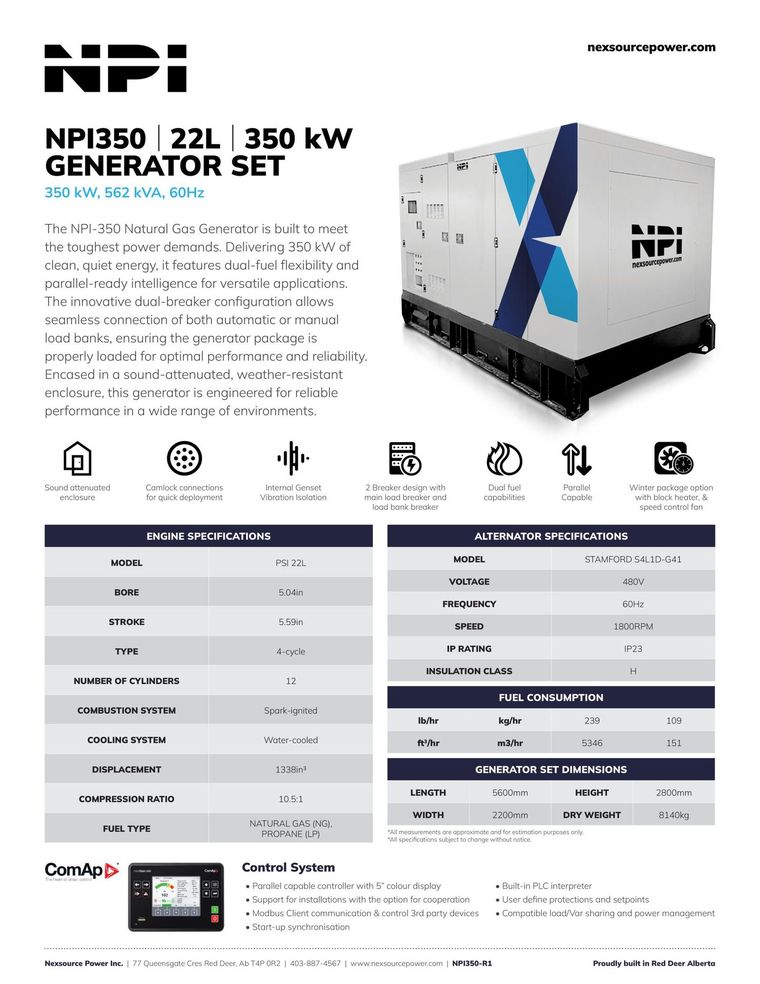
This is exactly why NexSource built the NPI series to be parallel-ready out of the box. Each unit ships with a ComAp parallel-capable controller (5" colour display) that handles start-up synchronization along with load and VAR sharing and power management natively, plus Modbus client communication for integrating with third-party monitoring or building automation systems. The synchronization and load-sharing logic isn't an add-on — it's part of the control system from the factory.
Benefit One: Capacity That Scales With Demand
The most immediate benefit of paralleling is straightforward — combined output. A single NPI-350 delivers 350 kW (562 kVA) at 480V/60Hz, built around a 12-cylinder PSI 22L engine (spark-ignited, water-cooled) paired with a Stamford S4L1D-G41 alternator, running on natural gas or propane. Pair two of them and you're at 700 kW, comfortably clearing a 600 kW target with headroom to spare. That headroom matters: it gives you margin for load growth, seasonal peaks, or equipment additions without immediately forcing another capacity decision.
Just as important is what this approach avoids. Instead of sourcing a single custom 600+ kW unit — often a longer lead time, a larger footprint, and a harder unit to transport or service — you're deploying multiple units from a proven, standardized product line. If demand grows again next year, you add another NPI-350 to the bus rather than replacing what you already own.
Benefit Two: Redundancy That's Built In, Not Bolted On
Capacity is only half the story. The other half is what happens when a unit goes down — whether that's an unplanned fault or routine maintenance.
A single large generator sized to exactly meet your load has no fallback. If it fails, or needs to come offline for service, the load has nowhere to go. Paralleling solves this through N+1 (or N+2) redundancy: you deploy more capacity than the load strictly requires, so the loss of any one unit doesn't mean the loss of power.
Applied to a 600 kW requirement, a three-unit NPI-350 configuration illustrates the point well. Three units provide 1,050 kW of total installed capacity — far more than needed — but in normal operation, two units run in parallel at roughly 300 kW each to serve the 600 kW load, while the third sits in reserve. If one of the active units trips offline, the remaining two units (700 kW combined) can absorb the full 600 kW load without interruption. The reserve unit can then be brought online to restore full redundancy. That's a meaningfully different risk profile than betting the entire load on one machine.
Benefit Three: Maintenance Without a Shutdown
Generators need scheduled service — oil changes, filter replacements, load bank testing, inspections. With a single unit carrying the full load, every one of those tasks either requires a planned outage or a temporary rental unit on site. With a paralleled fleet, you can drop one unit out of the rotation, service it, and bring it back online, all while the remaining units keep the facility powered. Over the life of a generator fleet, this alone can be the difference between maintenance being routine and maintenance being disruptive.
Benefit Four: Better-Matched Efficiency
Oversizing a single generator for a load that rarely reaches its full rating tends to mean running lightly loaded much of the time, which is hard on an engine and inefficient on fuel. A paralleled system can bring units online only as load actually demands it — running one unit at a well-loaded operating point during normal conditions and bringing a second online only when demand rises, rather than running one large unit underloaded around the clock. It's a more efficient match between generation and actual site demand.
Built for This from the Start
The NPI-350's dual-fuel (natural gas/propane) flexibility, 480V/60Hz output, sound-attenuated and weather-resistant enclosure, and optional winter package (block heater and speed-controlled fan) make it a practical building block for site conditions across Western Canada and beyond. Its two-breaker design — a main load breaker plus a dedicated load bank breaker — keeps the unit properly loaded whether it's paired with an automatic or manual load bank, and camlock connections make it fast to deploy on temporary or permanent sites. Combined with the ComAp controller's built-in synchronization and load/VAR sharing, the platform is designed to fit directly into a paralleled, monitored power system rather than requiring significant rework to integrate one.
The bigger takeaway: getting to 600+ kW of reliable power doesn't have to mean sourcing one oversized, hard-to-service unit. Two or three parallel-ready NPI-350 units can deliver the same capacity — or more — with redundancy, serviceability, and future scalability that a single large generator simply can't match.
If you're evaluating a power system in the 600 kW-plus range, it's worth running the numbers on a paralleled NPI configuration against a single-unit alternative. The capacity math is similar; the reliability math usually isn't. For a site that needs a megawatt or more on rent, megawatt generator rentals shows the large single sets on rent next to the paralleled NPI blocks.
Have a project in mind? Reach out to the NexSource Power team to talk through load requirements, redundancy targets, and the right NPI configuration for your site.