

Data centers are the backbone of the digital economy, and as demand for computing power — particularly AI workloads — continues to accelerate, so does scrutiny of the energy and water footprint required to keep these facilities running. The good news is that the technologies powering and cooling today's data centers have advanced significantly, delivering measurable environmental benefits without compromising the reliability these facilities demand.
The Cooling Revolution: Closed Cycle Systems
Cooling has historically been one of the largest environmental cost centers for data center operations. Traditional open-loop and evaporative cooling systems can consume enormous volumes of water — some large facilities historically used millions of gallons per day just to keep servers within operating temperature.
Closed cycle cooling technology addresses this directly. Rather than continuously drawing in fresh water and discharging it (or losing it to evaporation), closed cycle systems recirculate a fixed volume of coolant through a sealed loop. Heat is transferred out of the loop via heat exchangers rather than through evaporative loss, which means:
- Dramatically reduced water consumption — often 90%+ lower than open-loop equivalents, since the same coolant is continuously reused rather than replenished
- Reduced strain on local water tables and municipal supplies, particularly important in water-stressed regions or agricultural communities
- Lower chemical treatment requirements, since a sealed loop is less exposed to contamination, scaling, and biological growth that require ongoing chemical dosing
- More predictable, stable operating temperatures, which improves equipment longevity and reduces the embodied-carbon cost of replacing hardware
When paired with modern heat exchanger design and, increasingly, waste heat recovery (redirecting rejected heat to district heating or industrial processes rather than simply venting it), closed cycle systems represent one of the clearest wins in reducing the environmental footprint of digital infrastructure.
Turbine Generators: Efficiency at the Source
Cooling only addresses part of the equation — the other half is how the electricity is generated in the first place. This is where modern aeroderivative gas turbine generators have made substantial gains over legacy generation technology.
Aeroderivative turbines — derived from jet engine technology and adapted for stationary power generation — offer several efficiency advantages over traditional industrial gas turbines and diesel generation:
- Higher thermal efficiency. Modern aeroderivative units can achieve simple-cycle efficiencies in the mid-40% range, and when configured in combined-cycle or with waste heat recovery, effective fuel utilization can climb significantly higher — meaning more usable energy is extracted from every unit of fuel burned.
- Lower emissions intensity. Higher combustion efficiency translates directly into reduced CO2, NOx, and particulate emissions per megawatt-hour generated, compared to older reciprocating engine or legacy turbine fleets.
- Fast ramp and load-following capability. Aeroderivative units can start and reach full load in minutes rather than hours. This matters environmentally because it allows these units to efficiently complement variable renewable generation (wind and solar), stepping in only when needed rather than running continuously as baseload — reducing overall fuel burn across a grid or microgrid system.
- Fuel flexibility. Many modern packages are designed to run on natural gas, with some capable of blending in hydrogen or renewable natural gas as those supply chains mature, providing a pathway to further emissions reductions without requiring a full technology replacement.
- Compact footprint per megawatt. Because aeroderivative units pack more power output into a smaller physical and mechanical footprint, the embodied environmental cost of materials, land use, and site development per MW of capacity is lower than bulkier legacy alternatives.
Taken together, these characteristics mean that a modern turbine generator fleet can deliver reliable, dispatchable power for data centers and industrial loads while burning meaningfully less fuel — and emitting meaningfully less — per unit of electricity delivered, compared to the generation technology it replaces.
Powering Progress Responsibly: NexSource Power and Indigenous Partnership
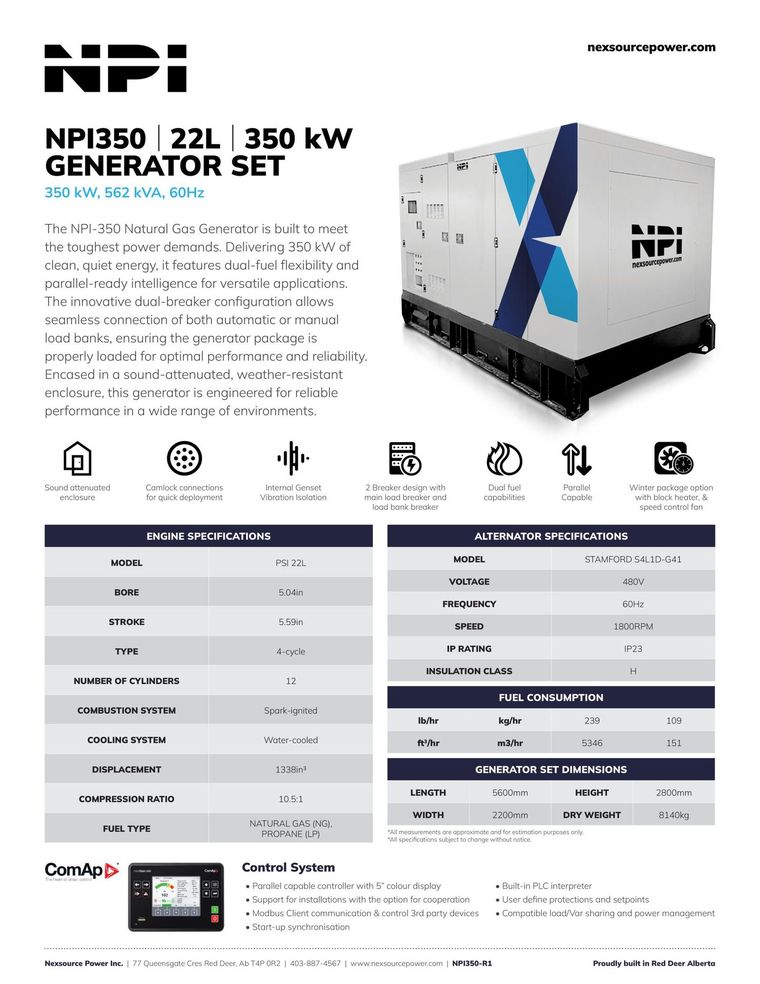
Technology alone doesn't define responsible power generation — the communities and land where that power is generated matter just as much. NexSource Power Inc. (NPI) is building its growth around this principle, pairing efficient, modern generation technology with genuine, structurally grounded partnerships with First Nations communities across Alberta. Rather than treating Indigenous engagement as a formality, NPI approaches these relationships as long-term partnerships — ones that position First Nations as equal stakeholders with real economic participation, a voice in project direction, and shared benefit that extends well beyond construction. Indigenous environmental stewardship — deeply rooted in generations of land and water knowledge — is treated as a guiding priority in how projects are sited, operated, and monitored, not an afterthought layered on at the end. As NPI continues to deploy efficient turbine generation to meet the growing power needs of industrial and data center clients, this commitment to authentic community partnership and environmental stewardship remains central to how the company defines progress: power that is not only cleaner and more efficient, but developed in a way that generates lasting, shared benefit for the communities it touches.